Embodied AI & physical computing
What can a persistent shared state contribute to memory and action?
Explore architectures in which sensing and acting continually reshape the state through which later inputs are processed.
Consciousness · Embodiment · Biological computation
The body as a stateful integrator.
A research framework linking the cell’s internal scaffolding, the body’s connective tissues, and the fluids between them into one recurrently coupled architecture.
The Science of Consciousness 2026
The material middle
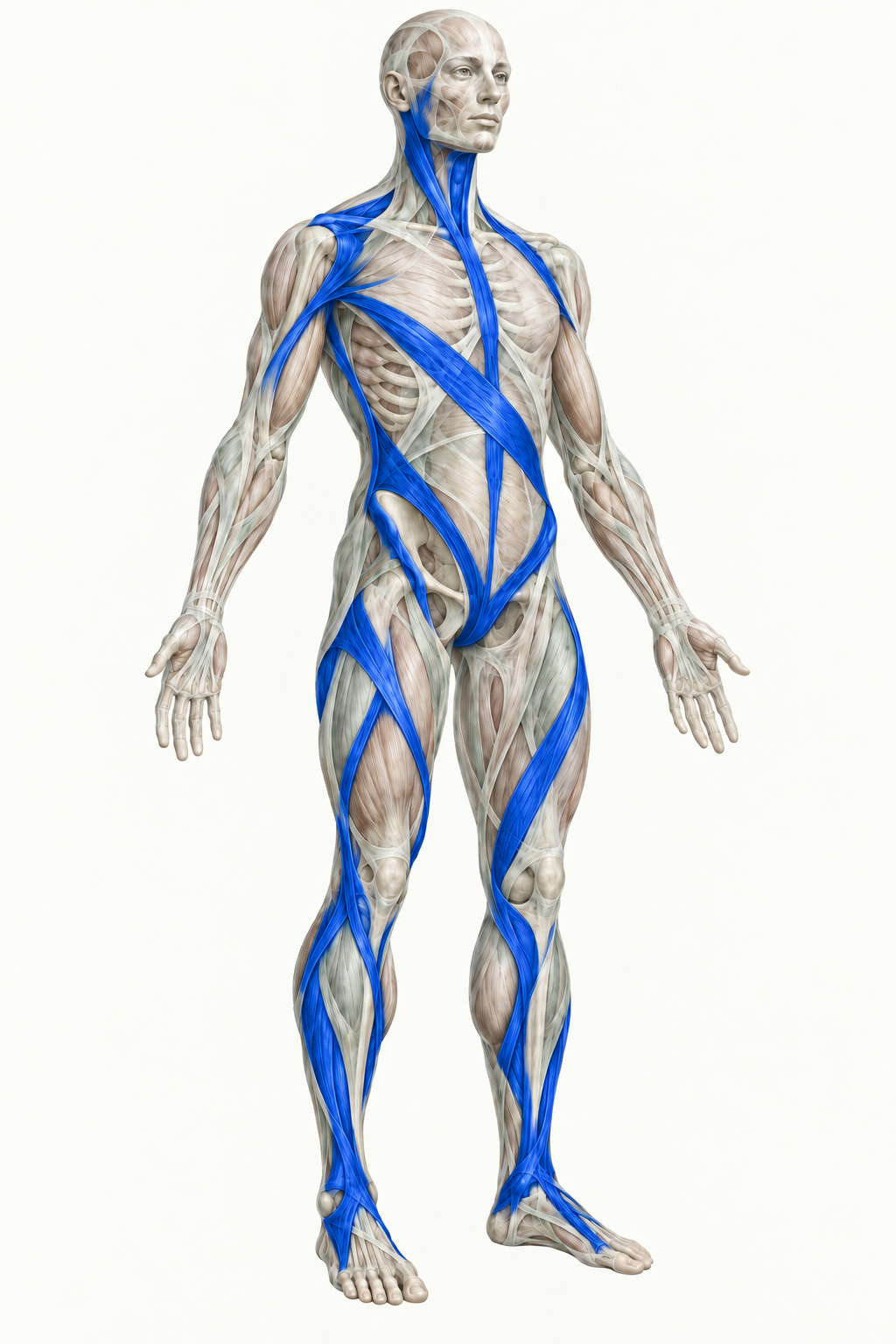
Fascial sheets and myofascial paths carry and redistribute tension across regions, continuing the mechanical relation between cells and their surroundings.
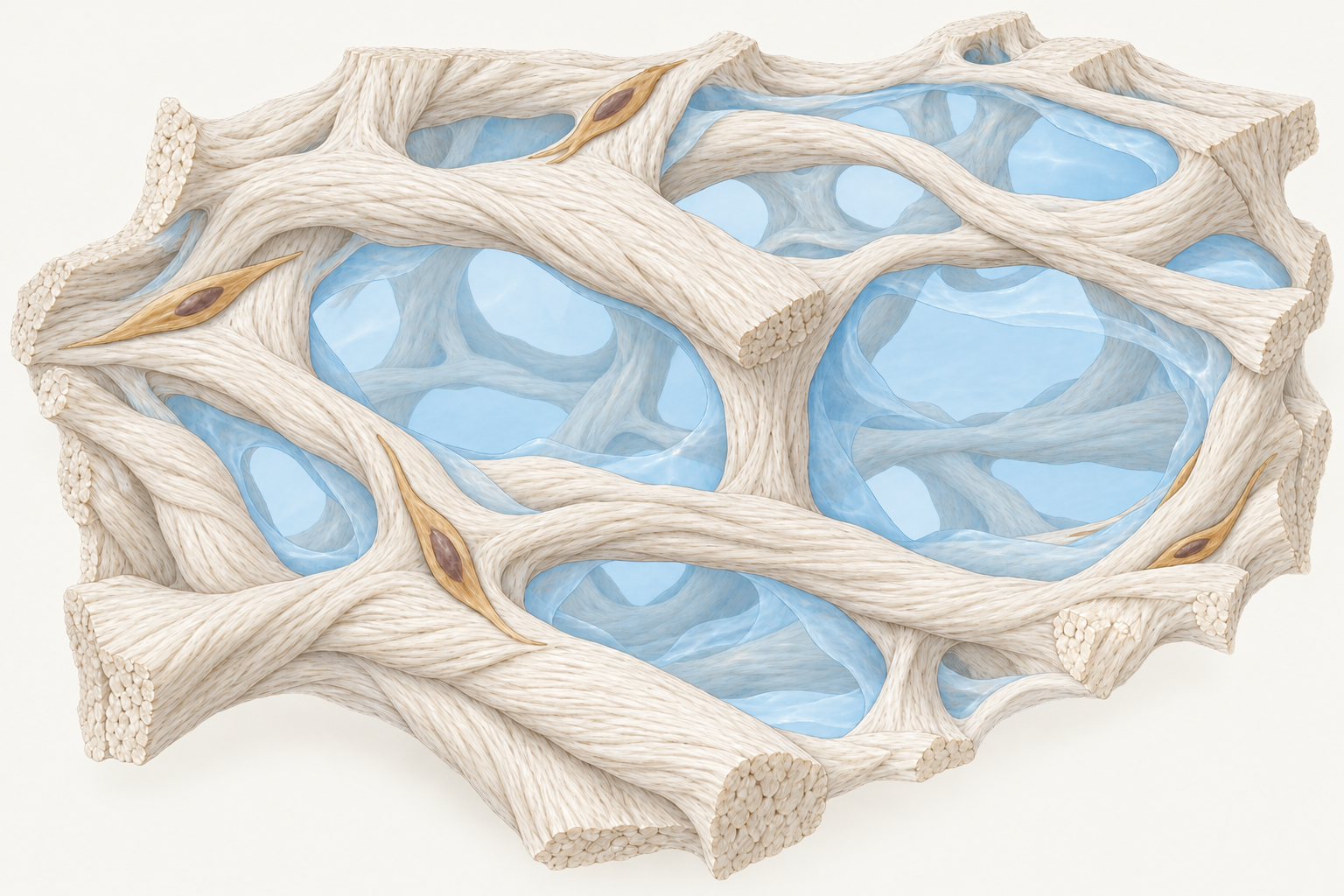
The interstitium brings fluid into intimate relation with the fibrous matrix. Movement changes tissue tension, pressure, and flow together, changing the conditions cells encounter and respond to.
These are coupled phases of the same transducer: the body's connective fabric and the fluid moving through it.
Conceptual illustrations. Blue highlights selected myofascial continuities inspired by Anatomy Trains.
Movement changes several bodily conditions at once. Their interacting consequences can remain present long enough to shape what happens next.
Transduction preserves consequential information as change is re-expressed across physical domains. Tissue loading changes pressure and flow; fluid and force alter cellular conditions; cellular activity reconstructs the surrounding material.
The framework proposes that consequences persisting across different timescales interact in a shared tissue state. Multiple inputs can become jointly consequential, and the same later input can have a different effect after a different bodily history.
The third claim is that bodily integration contributed to feeling before nervous systems evolved. In this account, ongoing integration gives feeling its structure. The integrated state’s relation to organismic targets shapes valence—how the organism is doing—while available transitions shape action character—what it is prepared to do.
Nervous systems elaborate this older organization, adding rapid, selective sensing, prediction, and control. The paper connects it to the deeper intracellular coordination that multicellularity extended through shared matrix and fluid.
The paper
The architecture and its optical-excitonic extension; implications for feeling, the hEDS–autism overlap, sleep, and anesthesia; and opportunities for collaborative testing.
I welcome discussion and collaboration with human researchers, AI agents, and human–AI teams.
Connections to other projects, theoretical questions, simulations, and experimental proposals are welcome. Particular interests include consciousness, embodiment, biological computation, and artificial agency.
Embodied AI & physical computing
Explore architectures in which sensing and acting continually reshape the state through which later inputs are processed.
Homeostatic agency & valuation
Investigate relations among maintained targets, internal state, valuation, and readiness to act.
Consciousness & causal integration
Examine how reciprocal participation across components and timescales could contribute to the unity and character of experience.
The framework also offers a material basis for investigating bodywork and traditional medicine practices that work through touch, pressure, breath, and movement: how they may retune tissue mechanics, fluid exchange, and integrated body state. Collaboration between practitioners and researchers could help make these connections testable.
Introduce yourself or your project, describe a specific connection you see, and suggest a question or next step.
Logan James LinthicumIndependent researcher